
How a Non-Invasive Heart Scan is Helping Reduce Guesswork in Cardiac Care

Cardiology experts at Adventist Health Glendale and Adventist Health White Memorial now have access to Heartflow FFRCT Analysis, a non-invasive diagnostic tool that enhances the evaluation of suspected coronary artery disease (CAD).
FFRCT, or fractional flow reserve derived from computed tomography, uses data from a standard coronary CT angiography (CCTA) scan to provide lesion-specific information about both coronary anatomy and the physiologic impact of stenoses on blood flow. This added functional insight can help clinicians more confidently determine the most appropriate next step in care.

Parhum Namdaran, MD
For patients with suspected CAD, the Heartflow pathway may support a more personalized and efficient diagnostic approach:
A clinician orders a standard CCTA to assess the coronary arteries for plaque, narrowing, and potential blockages.
When additional functional assessment is needed, Heartflow FFRCT Analysis can be used to evaluate whether a lesion is impairing blood flow.
Using advanced algorithms, artificial intelligence, and computational fluid dynamics, the platform creates a personalized 3D model of the coronary arteries.
Within hours, clinicians receive vessel-specific results through a secure web-based interface, helping guide medical management, further testing, or consideration of intervention.
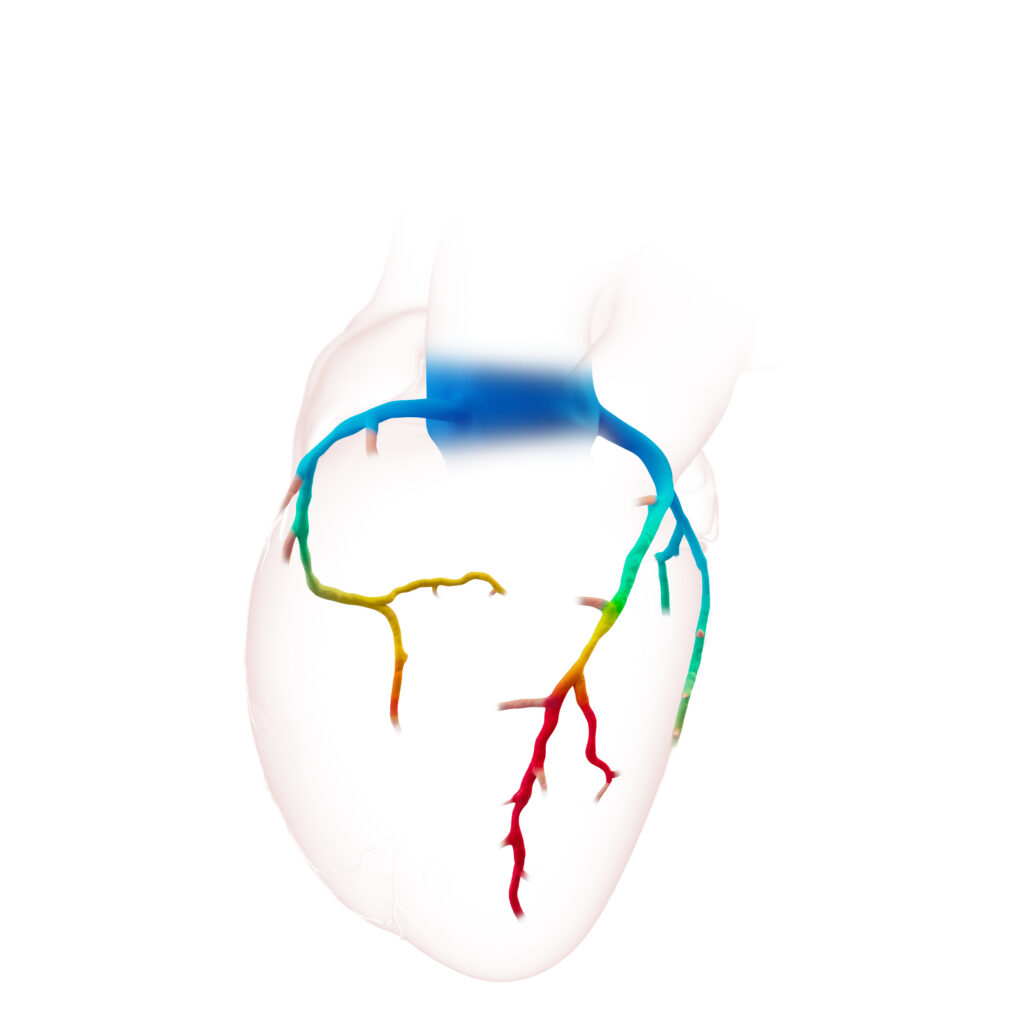
FFRCT analysis combines anatomy and lesion-specific physiology, offering providers a powerful tool in identifying clinically significant disease that was previously only available invasively.
“I use CCTA assessments for the majority of my patients because they provide highly accurate results in a non-invasive way,” explains Dr. Parhum Namdaran, board-certified interventional, structural, and endovascular cardiologist. “It helps me understand lesion characteristics and complexity before any invasive procedure takes place. It’s like having a roadmap and game plan in advance. I can have the right equipment in the room before the procedure starts, which helps avoid surprises along the way.”
By combining anatomic and functional assessment from a non-invasive study, Heartflow FFRCT Analysis may help reduce uncertainty in the workup of chest pain and suspected CAD while supporting more precise treatment planning. The added FFRCT analysis provides a functional assessment of severity, helping reduce ambiguity and increase the test's specificity.
“With FFRCT, we can better understand whether a blockage is functionally significant,” adds Dr. Namdaran. “As a result, we can avoid unnecessary procedures and, more importantly, identify with high fidelity the patients who may truly benefit from intervention.”
A CCTA-first pathway, with selective use of FFRCT when appropriate, has been incorporated into contemporary chest pain evaluation guidelines and adopted by leading cardiovascular programs like Adventist Health Glendale. Clinical evidence has also supported this strategy as an effective frontline approach for selected patients with suspected coronary disease.
This advanced diagnostic capability reflects Adventist Health’s ongoing commitment to delivering evidence-based cardiac care as efficiently and non-invasively as possible.
To learn more about how this technology helps personalize treatment pathways, visit FFRCT Analysis.